Live updates: Follow the latest on Israel-Gaza
The escalating conflict between Israel and Hezbollah could result in an economic contraction of 10 per cent to 25 per cent in Lebanon this year, as vital sectors from agriculture to tourism are destroyed and critical infrastructure damaged, economists say.
Lebanon, which is already ailing under the weight of several crises from years of political deadlock and nearly 12 months of Israel-Hezbollah fighting, could be saddled with a “significant” economic downturn in early 2025, Keren Uziyel, senior country analyst for Middle East and Africa at the Economist Intelligence Unit (EIU), told The National.
The EIU had predicted a seventh consecutive year of economic contraction in Lebanon in 2024, even before Israel's attacks on Monday that marked the deadliest bombardment of Lebanon since 2006.
“The upsurge in fighting between Israel and Hezbollah since the pager attack and Israel's intense air offensive will have set back hopes of economic stabilisation even further,” Ms Uziyel said. “Lebanon's economy and infrastructure has already been so severely degraded by the economic crisis and years of political instability and poor management that it lacks the resilience to withstand even a relatively short military campaign of this scale.”
The intensified fighting is also likely to exacerbate supply problems and destabilise the Lebanese pound again, leading to a resurgence in inflation that had started to ease in recent months, she added.
-
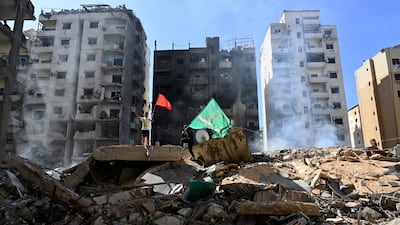
Damage in Beirut after an overnight Israeli strike. EPA -
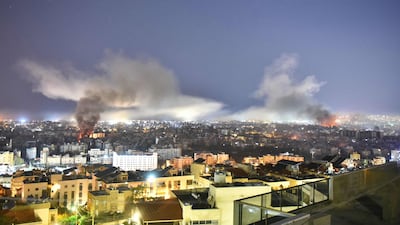
Smoke rises from the site of an Israeli strike in the south of Lebanon's capital. AFP -
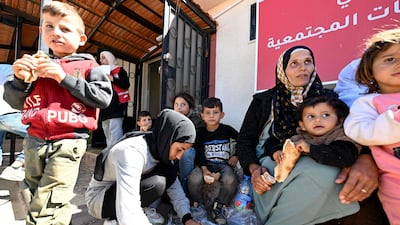
Displaced Syrians and Lebanese enter Syria from Lebanon at the Jusiyah border crossing. AFP -

The site of the Israeli air strike that killed Hezbollah leader Hassan Nasrallah, in Beirut. AP -
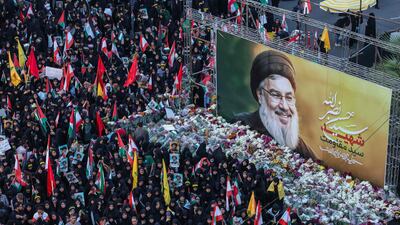
Iranians lay flowers before a portrait of Nasrallah. AFP -

Smoke billows over Tyre, southern Lebanon following an Israeli strike. Reuters -
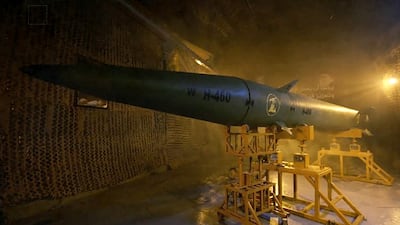
A Qader 1 ballistic missile from Hezbollah's arsenal. AFP -
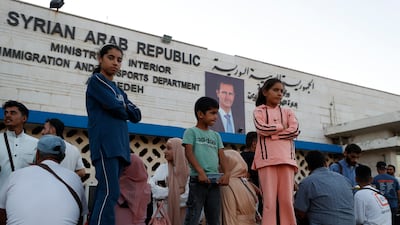
Syrians fleeing the war in Lebanon arrive at the Syrian-Lebanese border crossing in Jdeidet Yabous. AP -
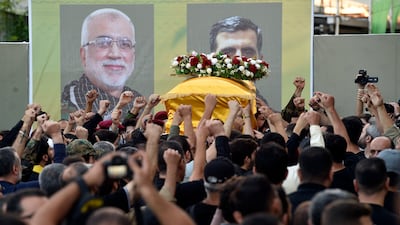
Hezbollah fighters carry the coffin of Hezbollah commander Ibrahim Qubaisi during his funeral in Beirut. EPA -
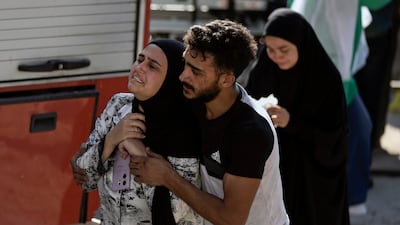
People react at the scene of an Israeli air strike in the town of Maisara, north of Beirut. AP -
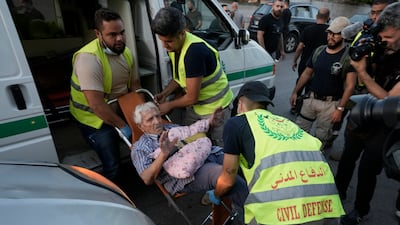
Civil defence workers carry an elderly man who fled from the south of Lebanon, as he arrives at a school turned into a displaced shelter in Beirut. AP -
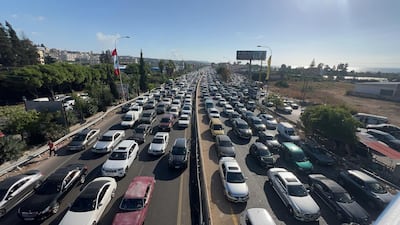
A traffic jam in Ghazieh as people fleeing from the south of Lebanon drive towards Sidon and Beirut. EPA -
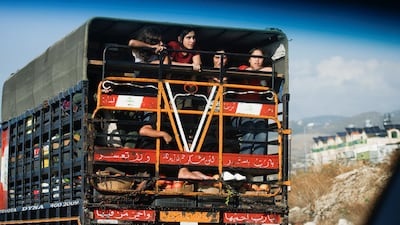
People in heavy traffic drive north from Lebanon's southern coastal city of Sidon, as they flee Israeli bombardment. Reuters -
Smoke billows over southern Lebanon following Israeli strikes, as seen from Tyre. Reuters -
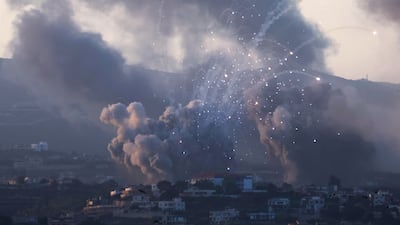
Smoke billows over southern Lebanon following Israeli strikes, as seen from Tyre. Reuters -
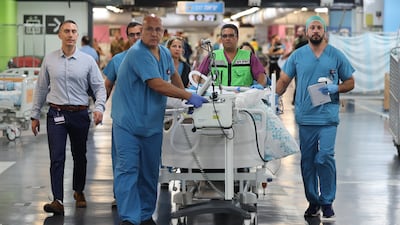
Medics move patients at Rambam Hospital's underground emergency centre, in Haifa, northern Israel. EPA -
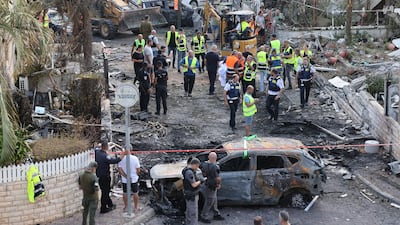
Israeli emergency teams work at the scene of a missile strike on a residential neighbourhood in Kiryat Bialik, northern Israel. EPA -
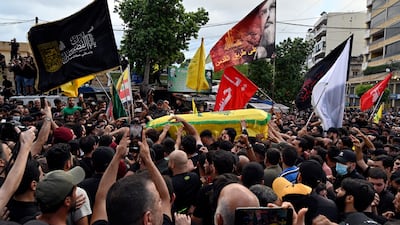
Hezbollah fighters carry the coffin of the group's senior commander Ibrahim Aqil, who was killed in an Israeli strike on September 20, in Beirut. EPA -
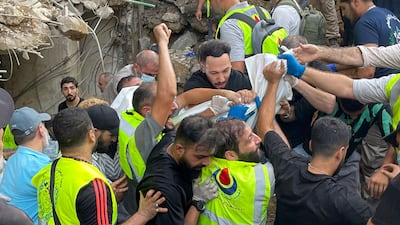
Rescuers carry a body at the scene of a missile strike in the southern suburbs of Beirut. AP


Israel's conflict with Lebanese group Hezbollah turned into an open-ended war on Monday after the Israeli military launched its most intensive air assault yet on south of the country. The attacks killed hundreds in Lebanon, with the Iran-backed group responding by firing rockets as far as Haifa, Tel Aviv and the occupied West Bank.
Israeli fighter jets struck southern Lebanon and the eastern Bekaa Valley on Tuesday in a second day of air strikes targeting Hezbollah.
Lebanon's Ministry of Public Health reported the that strikes, the heaviest aerial bombardment since the 2006 war between Israel and Hezbollah, had killed at least 558 people, including 50 children and 49 women, with 1,835 injured.
-
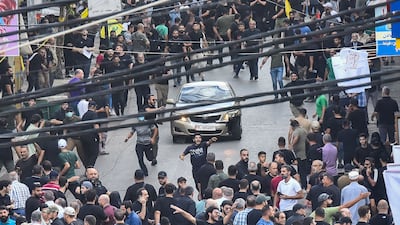
People react around a car after a reported explosion during a funeral. AFP -
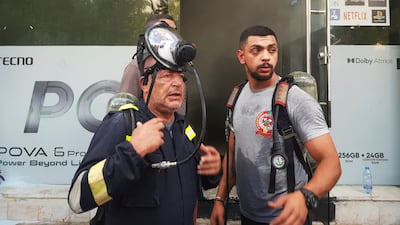
Firefighters stand outside a mobile phone shop after walkie-talkies exploded inside, in the southern port city of Sidon. AP -
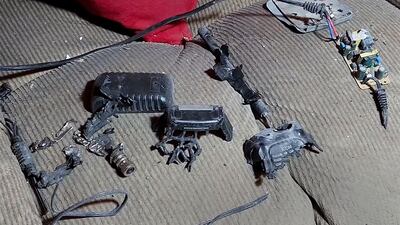
A walkie-talkie that exploded inside a house in Baalbek, east Lebanon. AP -
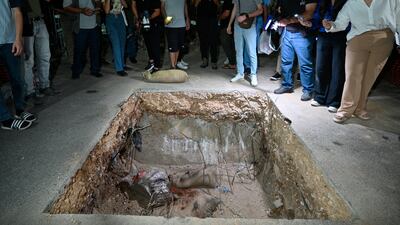
Lebanese army soldiers blow up a communication device next to the American University of Beirut. EPA -

Mourners carry the coffins of victims who were killed on Tuesday after their handheld pagers exploded, during their funeral procession in the southern suburb of Beirut. AP -
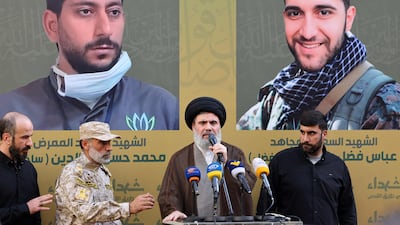
Hashim Safieddine, a Shiite Muslim cleric and head of Hezbollah's Executive Council, speaks at a funeral in Beirut's southern suburbs. AFP -
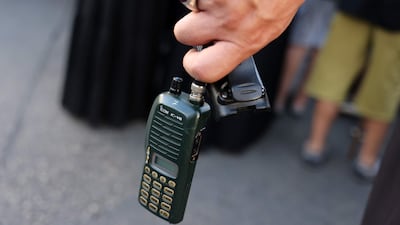
A man holds a walkie talkie device after he removed the battery during a funeral. AFP -
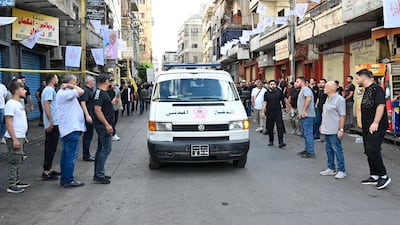
An ambulance arrives in the southern suburb of Beirut after blasts were reported. EPA -
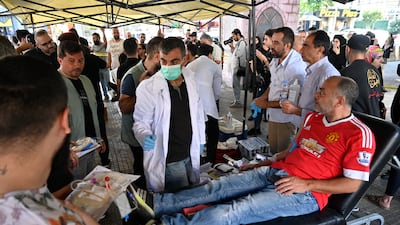
A man donates blood, one day after the explosions. EPA -
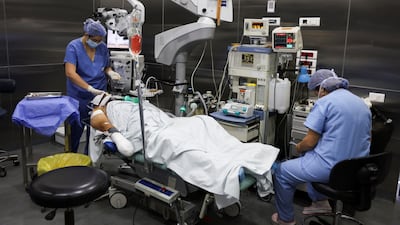
An injured man undergoes an operation, following the explosions. Reuters


The unfolding humanitarian crisis is adding to the financial misery that has gripped Lebanon, with economists lowering their projections for the year.
“Given that the worst-case scenario has materialised and Israel started its war on Lebanon, I expect a more severe contraction in economic activity in 2024 that could range from 6 per cent to 10 per cent this year, depending on the length and scale of the war,” Nassib Ghobril, chief economist and head of research at Beirut's Byblos Bank Group, told The National.
As a result of the heightened war, consumption will be limited to essential goods, travel will be severely disrupted, which will affect the tourism industry, investment will be further delayed and the rate of imports will be lower than the $17.5 billion worth in 2023, Mr Ghobril said.
Lebanon's Ministry of Finance is forecasting a fiscal surplus of 2 per cent of gross domestic product this year based on the performance of public finances in the first eight months, but Mr Ghobril projects the fiscal balance to range from zero per cent of GDP to a deficit of 1 per cent due to the intensified fighting.
Nasser Saidi, a former economy minister and vice governor of Lebanon's central bank, told The National a widening of conflict to include a ground attack would be devastating, including through further loss of GDP, exports, remittance, inflow of foreign direct investment, and emigration.
“A further escalation into a wider war, with strikes and destroyed infrastructure, could see the economy contract by up to 25 per cent in 2024,” he said.
“War could also result in an interruption of remittances, increasingly in cash, which has been a major source of income for the impoverished population – remittances represent about 30 per cent of GDP – and of the foreign exchange required to pay for imports.”
Foreign trade, and travel and tourism will be directly affected, as will power, transport and a retail sector already hit by low purchasing power, he added.
The country's GDP, which has already contracted from $50 billion to $20 billion over the past five years, will undergo “additional contraction” said Marwan Barakat, chief economist at Bank Audi. “Growth will contract by at least 20 per cent in a long-lasting war scenario,” he said.
Inflation, which moderated recently, would go up to above 400 per cent assuming a long-lasting war, he warned.
Conditions in Lebanon may only begin to stabilise in the second half of next year and overall growth restored in 2026-27, the EIU warns.
Huge plunge in hotel revenue
One of Lebanon's major growth drivers is tourism, with the country increasingly dependent on foreign visitors for hard currency. Lebanon's direct tourism receipts totalled $5.4 billion last year, equivalent to about 25 per cent of GDP.
But the intensified fighting is causing this key economic engine to die out, industry chiefs and analysts say.
“War is the biggest enemy of tourism. The embassies of many countries have told their citizens to leave Lebanon. Tourism is at nearly zero now in Lebanon,” Pierre Achkar, chairman of the Lebanese Federation for Tourism and president of the Hotel Owners' Association, told The National.
Hotels in Lebanon have recorded an 80 per cent to 85 per cent plunge in revenue so far this year, while restaurant revenue has dropped 60 per cent during the same period, he said.
Lebanon, which has about 40,000 hotel rooms, has recorded an occupancy rate of only 10 per cent in its hotels in the year to date, while employment in hotels has halved, Mr Achkar said.
Reflecting on nearly one year of war, he sees little cause for an improving outlook.
“This will all last until the end of the year. It’s not getting any better. Even if there is a ceasefire, there’s a hesitation by people to come to Lebanon because all year we have been in this situation,” he said.
The conflict and instability have also taken a toll on Lebanon's crucial agriculture sector. Constant Israeli shelling has caused losses estimated at between $2.5 billion and $4 billion due to the destruction of farmlands and soil contamination from phosphorus bombs – a toxic chemical used by Israel.
“Destruction of farmland will have a near permanent impact on the agricultural sector, much of which is based in the south and the Bekaa, and its exports, the main source of income for the inhabitants of the south,” Mr Saidi said.
Additionally, severe damage to medical facilities and buildings, water and waste infrastructure, and closure of schools will have “longer-term implications” for health, sanitation and education in what is already one of the poorer regions of Lebanon, he added.
“Apart from the south and the Bekaa, the immediate impact will be felt on everyday activity – lower consumption – and tourism and its direct receipts: this will have a major impact on an economy that is already reeling from a severe economic and political crisis,” he said.
Mr Barakat said most sectors of the Lebanese economy have ground to a halt. “While sectors like tourism and agriculture are believed to be the most hit by the attacks, the industrial, real estate, trade and all service sectors were also severely hit by the adverse security conditions.”
'Dire' energy situation
Lebanon has been experiencing frequent and prolonged power cuts due to a continuing fuel crisis.
The country relies almost entirely on a deal with Iraq to supply fuel for its power plants, allowing the state company Electricite du Liban to provide little more than four hours of electricity a day to many.
Since the heavy fuel supplied by Iraq does not meet Lebanon's specifications, the contract signed in 2021 has been renewed twice, allowing Beirut to exchange the fuel on the international market for alternative types more suitable for its power plants, such as low-sulphur or gas oil.
“Looking at the current energy situation of Lebanon, the situation will become very dire very soon,” said Cyril Widdershoven, analyst at Strategy International. “At the same time, additional supplies from Iraq, Syria or other Arab [countries] will not be possible, as these supplies are also under pressure or directly threatened.”
Last month, Lebanon received up to 30,000 tonnes of gas oil from Egypt and another 30,000 tonnes of fuel oil from Algeria.
“The current escalation is going to have a detrimental impact on normal conventional oil and gas supplies,” Mr Widdershoven said. “No trader/shipowner will be taking the risk of having fuel vessels heading towards Lebanese ports while bombs are falling.”
Francesco Sassi, research fellow at Ricerche Industriali Energetiche in Bologna, Italy, said Lebanon's energy crisis is a “major roadblock” for the country's economy and security.
“Beirut is in fact immobilised by it as several attempts have failed in the past to solve the situation. Hezbollah knows this and the perils of an open conflict with Israel on the energy supplies to the Lebanese population.
“In case of a wider conflict, only international support from other Arab players would allow Lebanon to keep the lights on, making this network of energy supporters indirect agents in a possible war.”
Dented business sentiment
Business confidence has also weakened, with companies in Lebanon expressing concern over the economic outlook, according to the latest BlomBank PMI survey.
Jamil Naayem, associate director of Middle East and Northern Africa economics at S&P Global Market Intelligence, told The National the escalation in fighting will further dampen business confidence because of infrastructure damage and mass displacement.
“This is likely to further disrupt business sentiment and activity so long as the escalatory path lasts,” he said. “In our latest forecasting round on Lebanon, we projected real GDP to contract further in 2024, in low single digits.
“While the situation remains fluid, we will likely revise down further our growth forecasts for the near term if the conflict turns into an all-out war and persists well into next month.”
Investment is certain to be hit, said Mr Barakat. “There will be no investment … Investors turn to a wait-and-see attitude. Anybody that wants to open a restaurant, a business, a hotel, a factory would refrain on his investment decision.”
Lebanon’s medium to long-term economic prospects “hinge on the political will – that is still missing today – to undertake tangible and bold” economic, monetary and fiscal reform measures, Mr Naayem said.
This is in addition to a long recovery list of restructuring the banking sector, addressing structural woes, improving confidence and helping to revive the economy, he added.

